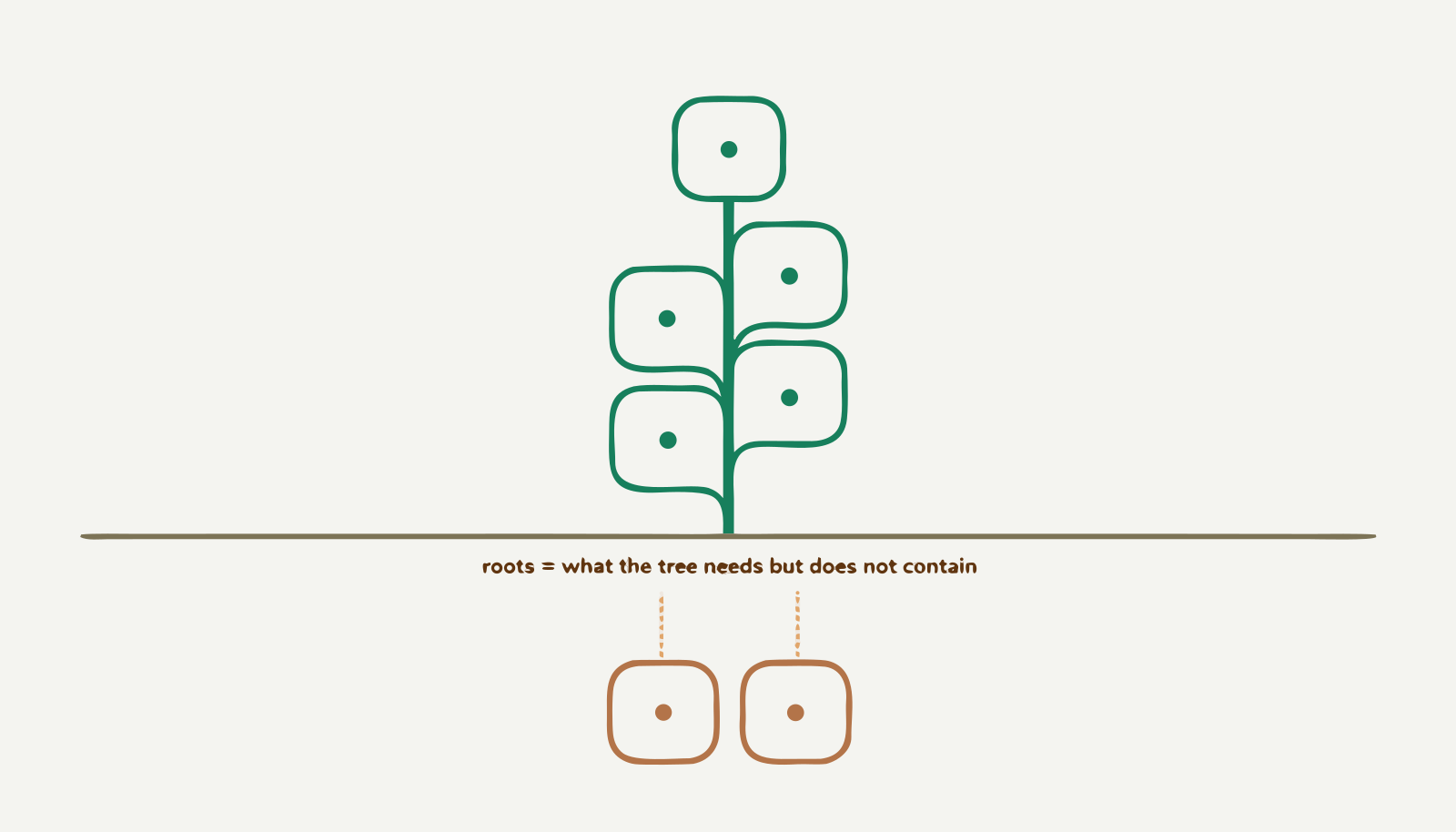
Roots are derived, not added
Every tree has roots — the skills you must already hold before you can enter the tree. And here's the elegant part: you never place roots by hand. The tree grows its own.
The derivation is mechanical. Look at the lowest skills in the tree — the ones whose prerequisites are not themselves in the tree. Those external prerequisites are the tree's roots, surfaced one level deep beneath it. In one line:
Roots = prerequisites of the tree's skills that aren't in the tree.
Say a "Frameworks" tree starts at "React I," and React I requires "JavaScript fundamentals" — a skill that lives in the JavaScript tree, not this one. Then JavaScript fundamentals appears as a root under the Frameworks tree. It isn't defined there (skills are defined only once); it's shown there, below the ground line, telling every reader: hold this before you climb here.
Why derive instead of declare?
- Roots can't go stale. Change a prerequisite on a skill, and every tree's roots update themselves. Hand-placed entry requirements drift; derived ones can't.
- Roots can't be wishful. Nobody can decorate a tree with aspirational entry bars that no skill inside actually demands. If it's a root, some skill in the tree genuinely requires it.
- It keeps the mental model whole. There is exactly one kind of connection in the method — the prerequisite. Roots aren't a second system; they're the same connections viewed from the other side of the tree's boundary.
Roots are the tree's honest answer to "am I ready to start this?" — and later, at the forest level, the same idea becomes the honest answer to "am I ready for this role?"
[Graphic — description for designer]A tree diagram with a clear horizontal "ground line." Above ground: the tree's skill nodes connected bottom-up. Below ground: two root nodes drawn in a different, earthier style, connected by dotted lines up to the lowest tree skills that require them. A small caption at the ground line: "roots = what the tree needs but doesn't contain." Flat style, forest green above, warm soil browns below, linen background.