Consistency without flattening
The moment more than one team runs forests, a tension appears. The organisation wants consistency — comparable levels, comparable ranks, reports that add up. Teams want fit — trees that match their work, not a committee's idea of it. Resolve this the wrong way and you either flatten every team onto one generic map, or fragment into private vocabularies nobody can compare.
The method's resolution fits in one line: share definitions, not whole trees.
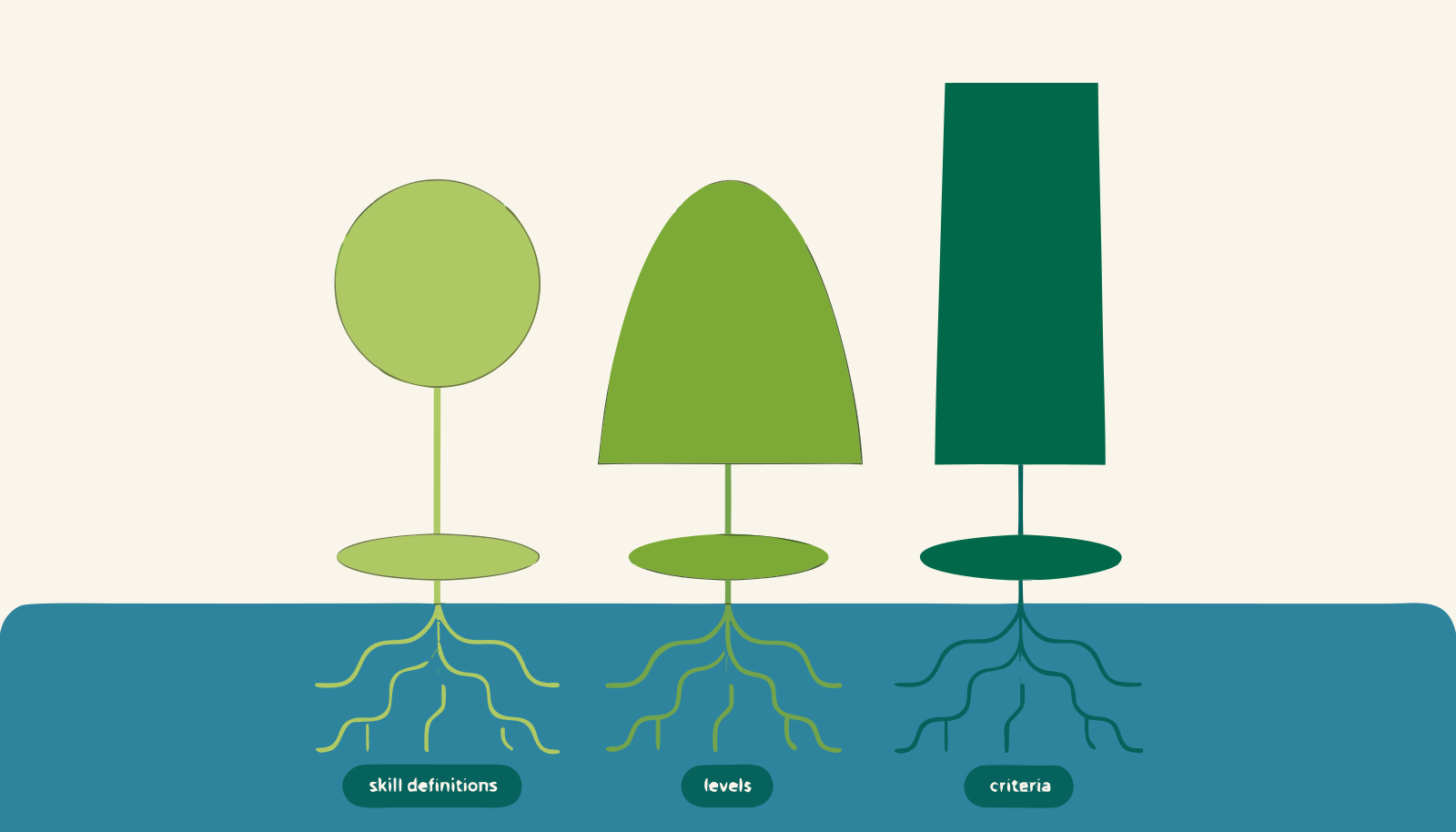
- Skill names and definitions — "React II" means the same thing everywhere it appears (skills are defined once, so this is already structural).
- The level scale — beginner / confident / expert, with the same behavioural tells.
- Assessment criteria — what counts as evidence for a level, including teaching-back.
What stays with each team:
- The trees themselves — which skills the team's work needs and how the area slices. Identical trees forced onto different work destroy exactly the fit that makes forests useful.
In short: teams own their trees; the organisation owns the vocabulary. A light central registry of skill definitions and ranks keeps reporting meaningful while every team keeps a map that matches its actual work.
And govern lightly. A small cross-area group — not a department, a handful of people — maintains the shared vocabulary and resolves naming clashes ("your 'API design' and their 'API design' are different skills; one of them needs a new name"). Its job is to keep the language coherent, never to approve trees. The moment governance becomes a bottleneck teams route around, the shared vocabulary dies with it.