Reporting and planning
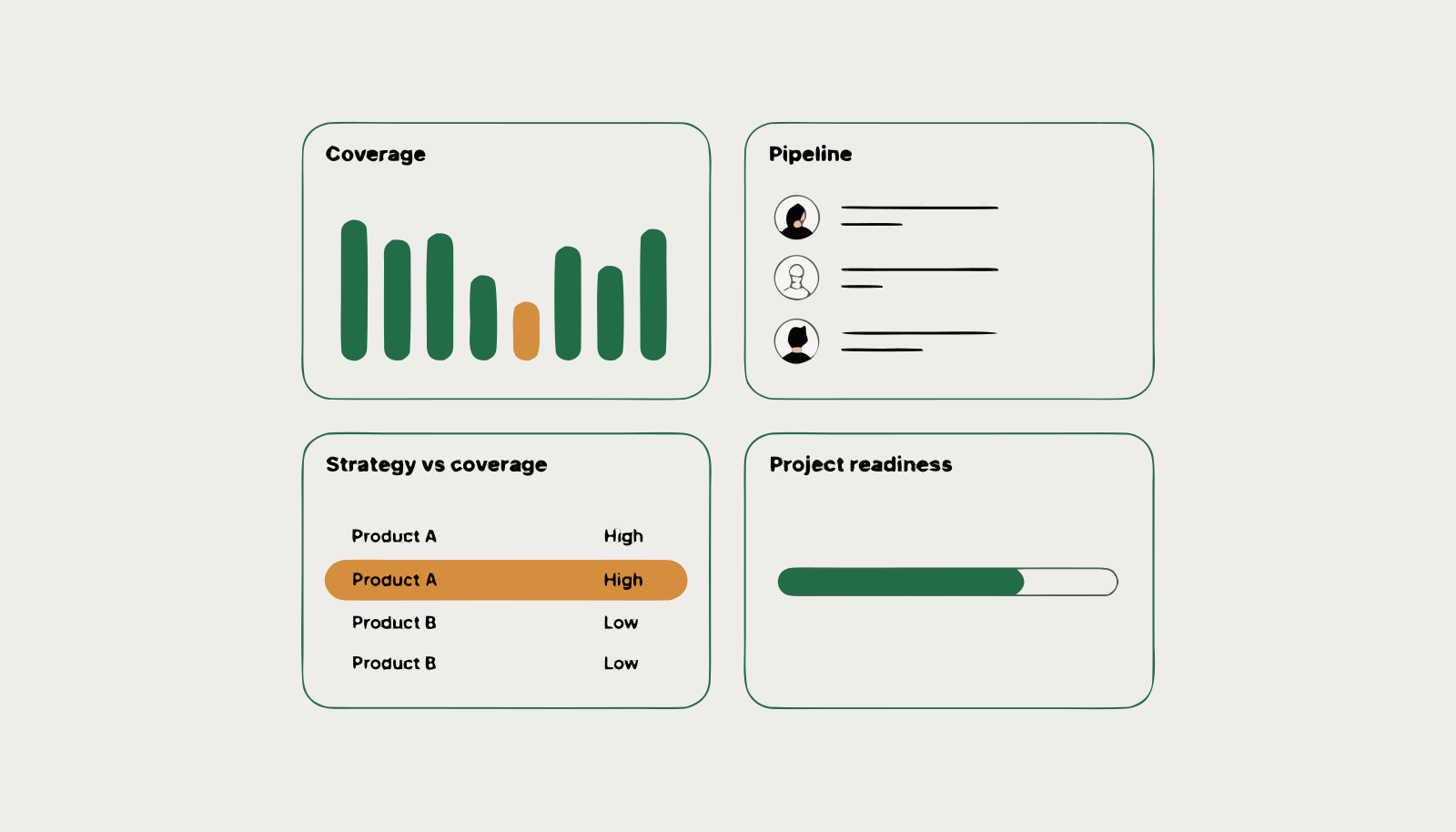
With every team's forest speaking the same vocabulary, the organisation gains four reads that used to require expensive guesswork.
Coverage and gaps. Which critical skills are thin org-wide? Where are the cross-team single points of failure — the one person in the whole company who holds a skill four teams depend on? Team-level maps each show their own risks; only the aggregated view shows the risks that live between teams.
Talent pipeline. Who's close to their next rank — nearly ready to step up, or step across? This turns succession from a name-on-a-napkin exercise into a live list: for each key position or rank, the people within a few skills of it, and exactly which skills. Development budgets can be pointed at the shortest real distances.
Capability vs. strategy. Take the next two years' priorities and read off the skills they'll demand — then compare against current coverage. The shortfall is the workforce-planning agenda: what to grow internally (and how long the prerequisite chains say that takes), what to hire (and against which derived entry bars), what to reconsider. Strategy meetings acquire an unusual property: the capability question gets answered with data.
Project readiness. Before committing to an upcoming project, read off the skills it needs and check how many people hold them, at what levels, and where the gaps are. "Can we staff this?" becomes a lookup instead of an opinion — and when the answer is no, the map shows the cheapest path to yes.
A note on spirit: these reads are for planning, not surveillance. The moment reporting makes individuals feel watched rather than developed, honest assessment — the input everything rests on — starts to corrode. Report on the forest; develop the people.