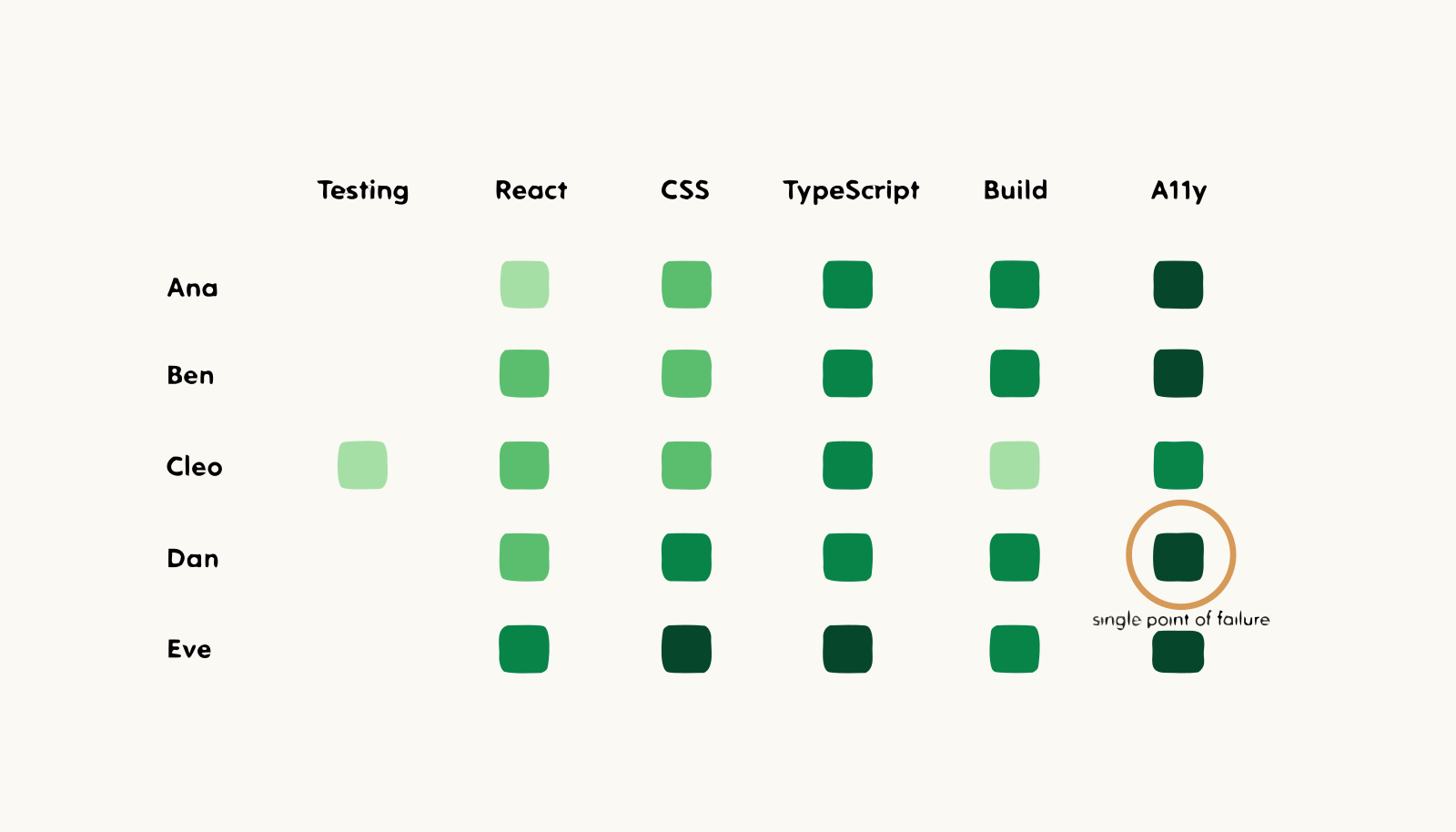
The team map
Point a forest at a team and it becomes something new: one picture of what the team can actually do. Three reads matter, in this order.
Coverage. For each critical skill: how many people hold it, and at what level? Read this first, because it's the first thing that breaks. A team's real capacity isn't its headcount — it's its coverage of the skills the work demands.
Gaps. Skills the team needs but nobody has — or holds only at beginner. A gap on a critical skill is a commitment you can't currently keep, discovered before you keep it. Gaps found on the map cost a plan; gaps found in production cost much more.
Single points of failure. Skills exactly one person holds at a usable level. This is the read leaders learn to fear productively: a skill with one confident owner is a risk the moment that person is on leave, busy, or gone. The map shows you every such skill today, while there's still time to grow a second owner.
The tool that makes all three reads instant is the skills heat map: team members down one axis, skills across the other, level in each cell. The whole forest becomes one glance — dark columns are strengths, thin columns are the work, and a column with a single dark cell is a single point of failure announcing itself.
Everything else in this chapter — planning, hiring, reviews, development — is a response to what these three reads show you.